...cell phones excite the brain. According to CNN.com, "Cell phone emissions excite the part of the brain cortex nearest to the phone, but it is not clear if these effects are harmful, Italian researchers reported on Monday."
The Ohoopee contacted Dr. Paddy Nobaddadie of the Southeastern Educational Research Group (SERG), an educational consulting company, for his response to the Italian report. He responded with, "We don't need school rooms filled with teenagers possessed of over-stimulated brains. I suspect expensive new editions of extra-somniative history textbooks will be required to offset this potentially dangerous situation. Perhaps a new shade of institutional brown for the walls would help as well. We have already begun the process of grant application to study this problem and expect results in six to ten years. One early trial balloon we are floating is Ritalin or a similar additive in the water supply. I mean, if fluoride hasn't destroyed our vital bodily fluids yet, why not Ritalin?"
The Committee to Reinvigorate Excellence in Education in the Public Schools (CREEPS), a special joint task force of the national educators' unions, have also expressed serious concern about the new research on the affect of cell phone use on the brain. CREEPS issued an immediate press release that calls for "significantly increased funding to address the impending collapse of the entire public education system if the effects of [fill-in-the-blank and delete this part] cell-brain stimulation (CBS) and the work of the current administration are not offset by large federal, state, and local distributions."
Peace
27 June 2006


Survival of the Fattest? An Update
When the Ohoopee first published the article Survival of the Fattest? on July 4, 2005, arguing that men with beer bellies should be excused as a quirk of Darwinian natural selection, the editors were unaware that other important scientific work had already been done in this area. Now there is this from CNN.com. A group of scientists has put together a "top ten" list of excuses for gaining weight that might just have scientific merit. Here is the list (emphasis mine):
1. Inadequate sleep. (Average sleep amounts have fallen, and many studies tie sleep deprivation to weight gain.)
2. Endocrine disruptors, which are substances in some foods that may alter fats in the body.
3. Nice temperatures. (Air conditioning and heating limit calories burned from sweating and shivering.)
4. Fewer people smoking. (Less appetite suppression.)
5. Medicines that cause weight gain.
6. Population changes. (More middle-agers and Hispanics, who have higher obesity rates.)
7. Older birth moms. (That correlates with heavier children).
8. Genetic influences during pregnancy.
9. Darwinian natural selection. (Fat people outsurvive skinny ones).
10. Assortative mating, or "like mating with like," as Allison puts it. Translation: fat people procreating with others of the same body type, gradually skewing the population toward the heavy end.
Food for thought, so to speak.
Peace
1. Inadequate sleep. (Average sleep amounts have fallen, and many studies tie sleep deprivation to weight gain.)
2. Endocrine disruptors, which are substances in some foods that may alter fats in the body.
3. Nice temperatures. (Air conditioning and heating limit calories burned from sweating and shivering.)
4. Fewer people smoking. (Less appetite suppression.)
5. Medicines that cause weight gain.
6. Population changes. (More middle-agers and Hispanics, who have higher obesity rates.)
7. Older birth moms. (That correlates with heavier children).
8. Genetic influences during pregnancy.
9. Darwinian natural selection. (Fat people outsurvive skinny ones).
10. Assortative mating, or "like mating with like," as Allison puts it. Translation: fat people procreating with others of the same body type, gradually skewing the population toward the heavy end.
Food for thought, so to speak.
Peace
26 June 2006
History Textbooks
I grow bored even reading the title of my post. Indeed, the term "history textbooks" is not one to fill a student with a giddy desire to discover the wonders of history. Instead, it fills the student with a sick dread of words bolded and definitions italicized by publishers that assume that the students are too stupid or too lazy to actually read and comprehend an entire paragraph. History textbooks are, by and large, awful. This is one of the two factors that lead so many people to hate history in high school. The other factor is the teacher.
For years I have struggled in vain to get my students to read their texts. I have assured them that there is vital information stored within the eye-catching pages of their hundred dollar tomes. I have tried pop quizzes, outlining, terms, questions, bonus points, oral quizzes, and concept mapping all with the same result: miserable failure.
The few students who actually read the text are unable to retain any meaningful information, and the vast majority figured out long ago that reading a history textbook may lead one to a fatal desire to insert round, metallic replicas of former presidents through one's eyes in hope of never having to read the abomination again, and, on top of that, one will learn little other than the fact that textbook publishing is a great gig. Recently, I have concluded that the best path (that is, the one of least resistance) is to teach students how to use their text as a reference work and to give up trying to force them to read it like a book since a thousand monkeys sitting at a thousand typewriters would quite likely create a book more interesting and informative than your average history textbook.
I bring this up because I am currently working on updating the reading assignments for my AP US History class. I am forced to complete this laborious task because we have had to update from the 5th to the 6th edition of Tindall/Shi's American: A Narrative History. It is a fine book and makes an excellent desk reference (I have a bunch of old editions for anyone who would like a free one).
The text is black and white, no words or definitions have been bolded, there are no review questions at the end of each chapter asking students who was the first oppressed minority to do something interesting, the text doesn't attempt to address the latest education fads with colorful sideboxs, little revisionist history finds it way into the book's interpretations of history, and it reads and looks like a decent book instead of a textbook. It also comes with the added bonus of being one of the cheapest AP US textbooks out there with a proven track record.
It is always interesting to see what cutting-edge historical research was deemed so important by the publishers as to warrant a new edition. So far, I have discovered that they have enhanced the brutal deprecations of white Virginia settlers against the Indians and themselves. Listen to this from page 54: "Severe even by the standards of a ruthless age, the code enforced a militaristic discipline needed for survival. When one laborer was caught stealing oatmeal, the authorities had a long needle thrust through his tongue, chained him to a tree, and let him starve to death as a grisly example to the community." Ouch. I don't remember that detail in earlier editions. And to think that some Americans today would be excited by such a punishment (the book doesn't report on the details, but I suppose it is possible the victim was wearing leather). Then the book describes an attack on an Indian village on the same page, "English soldiers attacked Indian villages and destroyed their crops." This is where a typical textbook would stop, but this one goes on: "One commander reported that they marched a captured Indian queen and her children to the river where they 'put the Children to death...by throwing them overboard and shooting out their brains in the water'."
The beauty of this book is that it does not focus merely on the sins of America [see Zinn, Howard], but also its successes. I know that by using this book I run the substantial risk of my students actually reading the book, enjoying it, and learning something. It is a risk I am willing to take. I look forward to what other gems they have inserted in this edition.
Peace
For years I have struggled in vain to get my students to read their texts. I have assured them that there is vital information stored within the eye-catching pages of their hundred dollar tomes. I have tried pop quizzes, outlining, terms, questions, bonus points, oral quizzes, and concept mapping all with the same result: miserable failure.
The few students who actually read the text are unable to retain any meaningful information, and the vast majority figured out long ago that reading a history textbook may lead one to a fatal desire to insert round, metallic replicas of former presidents through one's eyes in hope of never having to read the abomination again, and, on top of that, one will learn little other than the fact that textbook publishing is a great gig. Recently, I have concluded that the best path (that is, the one of least resistance) is to teach students how to use their text as a reference work and to give up trying to force them to read it like a book since a thousand monkeys sitting at a thousand typewriters would quite likely create a book more interesting and informative than your average history textbook.
I bring this up because I am currently working on updating the reading assignments for my AP US History class. I am forced to complete this laborious task because we have had to update from the 5th to the 6th edition of Tindall/Shi's American: A Narrative History. It is a fine book and makes an excellent desk reference (I have a bunch of old editions for anyone who would like a free one).
The text is black and white, no words or definitions have been bolded, there are no review questions at the end of each chapter asking students who was the first oppressed minority to do something interesting, the text doesn't attempt to address the latest education fads with colorful sideboxs, little revisionist history finds it way into the book's interpretations of history, and it reads and looks like a decent book instead of a textbook. It also comes with the added bonus of being one of the cheapest AP US textbooks out there with a proven track record.
It is always interesting to see what cutting-edge historical research was deemed so important by the publishers as to warrant a new edition. So far, I have discovered that they have enhanced the brutal deprecations of white Virginia settlers against the Indians and themselves. Listen to this from page 54: "Severe even by the standards of a ruthless age, the code enforced a militaristic discipline needed for survival. When one laborer was caught stealing oatmeal, the authorities had a long needle thrust through his tongue, chained him to a tree, and let him starve to death as a grisly example to the community." Ouch. I don't remember that detail in earlier editions. And to think that some Americans today would be excited by such a punishment (the book doesn't report on the details, but I suppose it is possible the victim was wearing leather). Then the book describes an attack on an Indian village on the same page, "English soldiers attacked Indian villages and destroyed their crops." This is where a typical textbook would stop, but this one goes on: "One commander reported that they marched a captured Indian queen and her children to the river where they 'put the Children to death...by throwing them overboard and shooting out their brains in the water'."
The beauty of this book is that it does not focus merely on the sins of America [see Zinn, Howard], but also its successes. I know that by using this book I run the substantial risk of my students actually reading the book, enjoying it, and learning something. It is a risk I am willing to take. I look forward to what other gems they have inserted in this edition.
Peace
21 June 2006
Cell Phones in the Classroom: Can You Hear Me Now?
In a darkened classroom, a group of freshmen is watching a DVD of Romeo and Juliet, the Zeffireli version. The teacher is seated in the back, not for a good view of the TV but for a good view of the students, for he knows that when the lights go down and the movie starts, students begin to believe that they are invisible. He keeps reminding himself to make sure to skip chapter 13 of the movie, or he will be in his bosses' office by the end of the day.
The first ten minutes of a movie are usually quiet and students actually watch the movie as they critically assess whether the material selected by the teacher actually merits their continued attention. After that, most students will turn their separate ways. Some will talk. Some will write notes to their loved ones. Some will catch up on sleep. Some will turn to electronic devices (generally cell phones and calculators, you wouldn't believe what you can do on a calculator these days). It is the teacher's job to make sure that none of that happens. On this day, most of the students are soon turned off by the Shakespearean dialogue and look for something else to do.
The school has a policy that allows students to possess cell phones, but that the cell phones must remain off and out-of-sight. Students caught in violation of this policy have their phones confiscated for the day, are assessed a $3.00 fine, and the parents are notified of the infraction. While some say that this punishment is a mere slap on the wrist, students really hate losing their phones for the day. If the phones are supposed to stay off and out-of-sight, why do they hate losing it for the day? The temptation is simply too great for a teenager to have a cell phone in his or her pocket and not to use it in some way. Students will exhibit urgent needs to use the bathroom, will text message without taking their phones out of their pockets (quite a talent), and even use them during movies when the dark gives them cover. The phones take pictures, record and show videos, play games, send and receive text messages, record voice mail, not to mention function as mobile phones.
As Romeo laments an unnamed Rosaline, the teacher notices a girl taking way too much interest in the contents of her purse. He waits a moment and the tell-tale glow of the cell screen briefly casts a pale-blue sheen across her face. He walks over to her; she is so involved in her text that she doesn't notice until he stands over her, watching her hunt and peck a message. She claims that her "received text message" light had gone off and thought it might be her mom with a message of vital import, could she check it? He takes it from her. She can get it at the end of the day. She was texting her boyfriend at another school about the boring movie that she was being forced to watch. Alas.
What are schools to do about the growing power and ubiquity of cell phones? They are powerful tools and convenient ways to transmit important information.
Two recent news stories highlight the unintended consequences of new technology. One, from CNN.com outlines the debate between the City of New York, which has banned student cell phones from school grounds and a number of parents who insist that their students have to have cell phones or they can't be good parents. The story can be found here. The second story, from Breitbart.com, reports on a new, high-pitched ringtone that is only hearable by the young and is the perfect tone for school use as the old, deaf teachers will not be able to hear it. This story can be found here. Older stories report on the use of cell phones for cheating, the inappropriate use of cell phone cameras in the locker room, and a host of other misdeeds enabled by the use of cell phones.
What did we do before cell phones?
Next on TOLN: "Ancient Discovery: Early Native American Shamans Disparage Students Use of New Smoke Signals; Children Burned, Obscene Messages Sent, Bugs Thrown in Fire"
Peace
The first ten minutes of a movie are usually quiet and students actually watch the movie as they critically assess whether the material selected by the teacher actually merits their continued attention. After that, most students will turn their separate ways. Some will talk. Some will write notes to their loved ones. Some will catch up on sleep. Some will turn to electronic devices (generally cell phones and calculators, you wouldn't believe what you can do on a calculator these days). It is the teacher's job to make sure that none of that happens. On this day, most of the students are soon turned off by the Shakespearean dialogue and look for something else to do.
The school has a policy that allows students to possess cell phones, but that the cell phones must remain off and out-of-sight. Students caught in violation of this policy have their phones confiscated for the day, are assessed a $3.00 fine, and the parents are notified of the infraction. While some say that this punishment is a mere slap on the wrist, students really hate losing their phones for the day. If the phones are supposed to stay off and out-of-sight, why do they hate losing it for the day? The temptation is simply too great for a teenager to have a cell phone in his or her pocket and not to use it in some way. Students will exhibit urgent needs to use the bathroom, will text message without taking their phones out of their pockets (quite a talent), and even use them during movies when the dark gives them cover. The phones take pictures, record and show videos, play games, send and receive text messages, record voice mail, not to mention function as mobile phones.
As Romeo laments an unnamed Rosaline, the teacher notices a girl taking way too much interest in the contents of her purse. He waits a moment and the tell-tale glow of the cell screen briefly casts a pale-blue sheen across her face. He walks over to her; she is so involved in her text that she doesn't notice until he stands over her, watching her hunt and peck a message. She claims that her "received text message" light had gone off and thought it might be her mom with a message of vital import, could she check it? He takes it from her. She can get it at the end of the day. She was texting her boyfriend at another school about the boring movie that she was being forced to watch. Alas.
What are schools to do about the growing power and ubiquity of cell phones? They are powerful tools and convenient ways to transmit important information.
Two recent news stories highlight the unintended consequences of new technology. One, from CNN.com outlines the debate between the City of New York, which has banned student cell phones from school grounds and a number of parents who insist that their students have to have cell phones or they can't be good parents. The story can be found here. The second story, from Breitbart.com, reports on a new, high-pitched ringtone that is only hearable by the young and is the perfect tone for school use as the old, deaf teachers will not be able to hear it. This story can be found here. Older stories report on the use of cell phones for cheating, the inappropriate use of cell phone cameras in the locker room, and a host of other misdeeds enabled by the use of cell phones.
What did we do before cell phones?
Next on TOLN: "Ancient Discovery: Early Native American Shamans Disparage Students Use of New Smoke Signals; Children Burned, Obscene Messages Sent, Bugs Thrown in Fire"
Peace
Wednesday Miscellany
Friday will be the one-year anniversary of The Ohoopee Letter News' experiment in publishing on the internet. It has been much more difficult than I had imagined to consistently update this space with something that someone might find interesting to read. At the same time, it has been fun to experiment with different voices, practice writing, and talk about my family. It has been an exciting year, and I have posted one hundred and forty-seven times and have gotten almost 3,100 hits during that time. Thanks to all of you who have stopped by and continue to stop by. At the risk of being narcissistic, my personal favorite post is this one: Dean of Men Breaks the Case of the Fishy Finals.
Whenever I think I might be becoming too narcissistic, I remember that I have a blog (which confirms it).
Next year I will be teaching: AP US History, Government/Economics, and AP European History. During the second week of July I will be attending a one week AP European Institute at Oglethorpe University. I will let you know how it goes. It will be a challenging year as we are also undergoing dual accreditation this year.
We watched Chicken Little for super-duper family movie fun night a few days ago. The children enjoyed it quite a bit and the adults got a few good laughs. The boy couldn't quite understand why we didn't buy it and why we have to return it. He grew a bit irate with me. A coupon for $1.99 movie rentals at Blockbuster for the month of June was beyond his understanding. The coupon also allowed me the pleasure of watching Serenity and The Great Raid, both fine movies. In addition, the wife and I watched Aeon Flux. Two dollars was too much to spend in renting that movie.
My current project involves the renovation of our downstairs bathroom. Instead of renting a wet tile saw ($44.00 a day), I spent yesterday using tile nippers to cut in the tile around the toilet flange (I hope the use of the word "nippers" doesn't put me at the end of any weird search results). The boy checked my progress about every ten minutes, and I ended up finishing the job but with blistered and sore hands today. Working around the toilet reminded me of my favorite ad for plumbing services: "A straight flush beats a full house!"
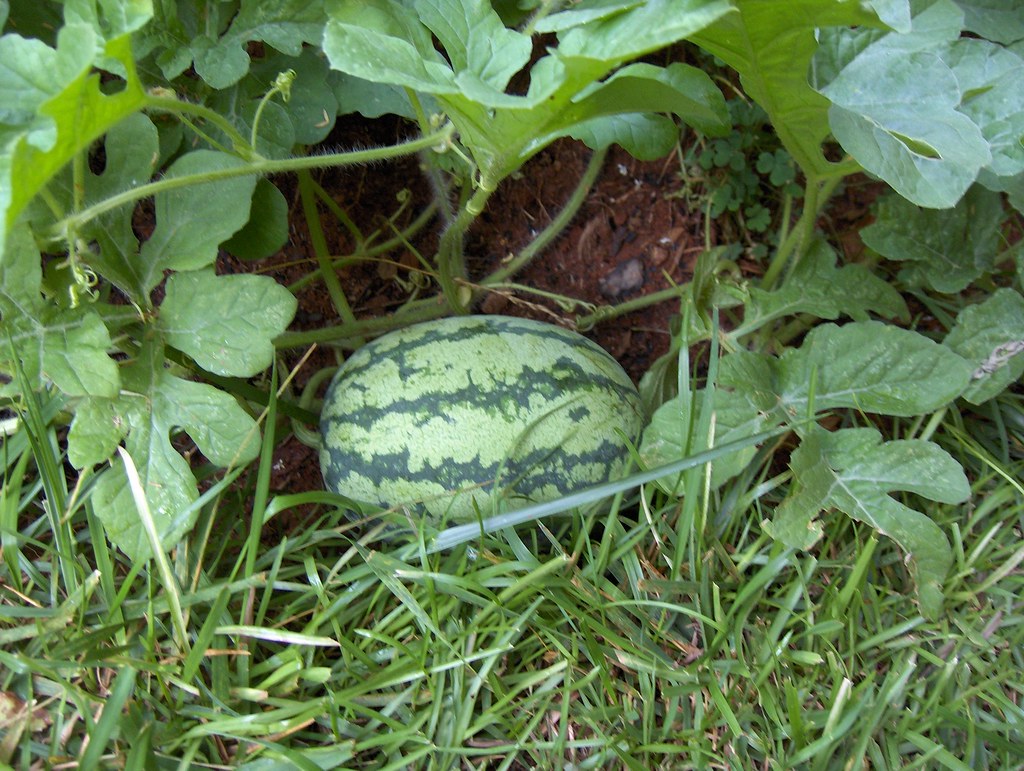
My watermelons continue to thrive. My most mature watermelon has reached almost seven inches. However, I can't seem to stop a feeling of impending doom...that some evil fungus or blossom end rot or a very large rabbit will destroy my lovely crop.
Peace
Whenever I think I might be becoming too narcissistic, I remember that I have a blog (which confirms it).
Next year I will be teaching: AP US History, Government/Economics, and AP European History. During the second week of July I will be attending a one week AP European Institute at Oglethorpe University. I will let you know how it goes. It will be a challenging year as we are also undergoing dual accreditation this year.
We watched Chicken Little for super-duper family movie fun night a few days ago. The children enjoyed it quite a bit and the adults got a few good laughs. The boy couldn't quite understand why we didn't buy it and why we have to return it. He grew a bit irate with me. A coupon for $1.99 movie rentals at Blockbuster for the month of June was beyond his understanding. The coupon also allowed me the pleasure of watching Serenity and The Great Raid, both fine movies. In addition, the wife and I watched Aeon Flux. Two dollars was too much to spend in renting that movie.
My current project involves the renovation of our downstairs bathroom. Instead of renting a wet tile saw ($44.00 a day), I spent yesterday using tile nippers to cut in the tile around the toilet flange (I hope the use of the word "nippers" doesn't put me at the end of any weird search results). The boy checked my progress about every ten minutes, and I ended up finishing the job but with blistered and sore hands today. Working around the toilet reminded me of my favorite ad for plumbing services: "A straight flush beats a full house!"
My watermelons continue to thrive. My most mature watermelon has reached almost seven inches. However, I can't seem to stop a feeling of impending doom...that some evil fungus or blossom end rot or a very large rabbit will destroy my lovely crop.
Peace
Subscribe to:
Posts (Atom)